Kanji & identification
How to read the mei (kanji signature) on a Japanese knife
In Sakai, the name goes on last, cut by hand after the smith, the sharpener and the handle-fitter have finished. That order explains most of what a mei can tell you, and most of what it can't.
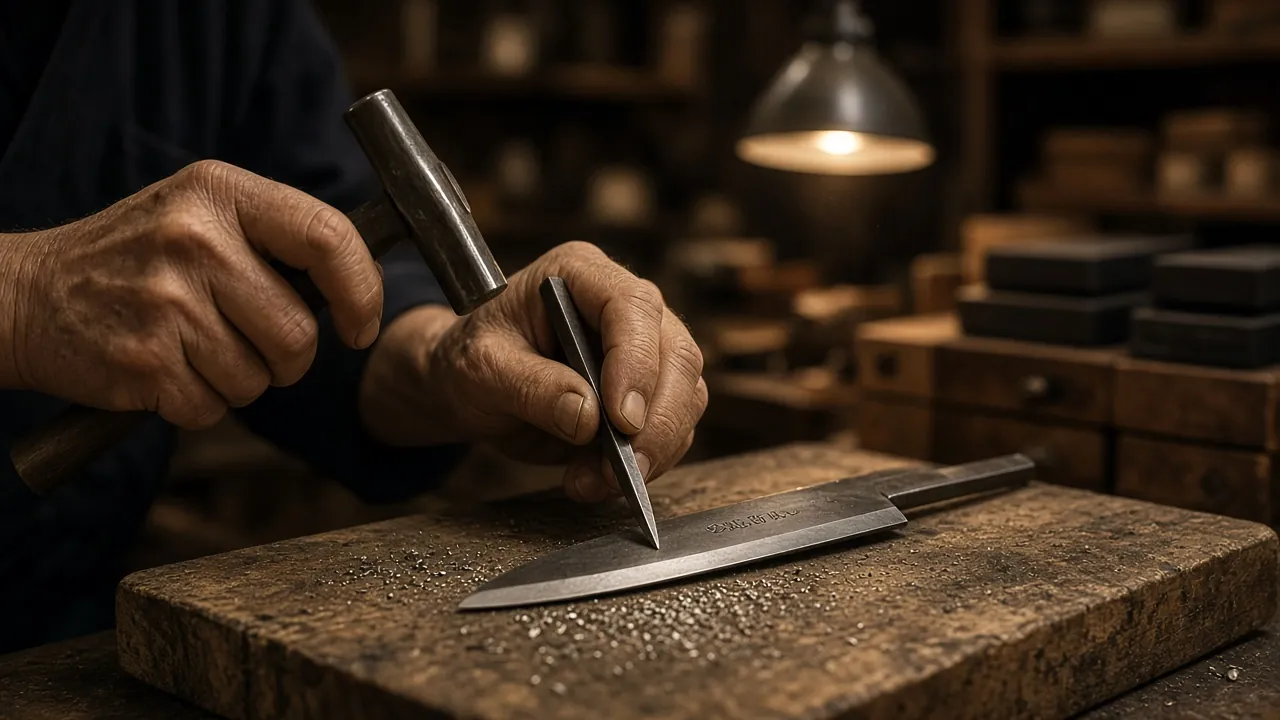
The last hands on the knife
In a Sakai workshop, Michiko Kubota cuts names into steel. She engraves for Aoki Hamono, the company behind Sakai Takayuki, and a 2024 profile by Asahi Broadcasting counted about 700 knives a month going under her chisel. She cuts brand names, customers' names, restaurant names, mottos, and now and then a small picture3. The profile calls the craft meikiri, 銘切り, "cutting the mei", and traces it back to Japanese swords3.
Her work comes at the very end. Sakai's tourism bureau describes a knife passing from smith to sharpener to handle-fitter, and only then getting its name, struck with a hammer and a small chisel called a tagane2. Sakai is said to make most of the knives used by Japanese restaurant cooks16, so this order shapes a large share of the marks you will ever see.
Keep that sequence in mind. The person who cuts the name is rarely the person who forged the blade, and the name she cuts is usually the brand's.
What the word means
Mei is the Japanese word for an inscription. Dictionaries give a second sense that matters here, a maker's engraved signature1. On a kitchen knife it is the short line of kanji on the side of the blade. Translating it is the easy part. Knowing whose name it is takes more work.
Which side to check first
Traditional single-bevel knives, the yanagiba, deba and usuba, carry the mark on the flat face called the hira. The maker Nenohi defines the hira as the surface where the product name is engraved7. A Japanese tool enthusiast who went through his own knives found the mark on single-bevel blades always sat on the face that points right when you hold the knife. That is the side with the ridge, the shinogi, and the bevel, and it is why that face is called the front, omote6.
Double-bevel knives are less tidy. The same writer found that nakiri mostly follow the single-bevel habit, with some marked on the left. On gyuto and other Western shapes he saw no fixed rule, though Japanese makers marked the right face somewhat more often6. If one side looks blank, turn the knife over before you decide it has no mei.
A second line of characters under the brand may not belong to the maker at all. Shops in Sakai engrave names for visitors2. Aritsugu, the Tokyo knife shop, hand-engraves customers' names on Japanese-style knives on the same face as its own mark, usually just below it8. On Western-style knives Aritsugu puts names on the metal bolster, or lasers them onto the blade8. That neat second line could be a cook who owned the knife before you.
Reading a mark from the end
Most marks run in a loose order. A place comes first, then a name, then a word meaning "made". Start at the bottom. If the last character is 作, saku, you have found the end of the signature, and the name sits directly above it. 作 means a work or a production31. Knifewear translates 藤原照康作 on a Teruyasu Fujiwara nakiri as "Fujiwara Teruyasu saku", made by Teruyasu Fujiwara10.
Now a harder one. The Sakai wholesaler Daikichi cuts the mark 堺一文字吉國作 by hand, and a Sakai trade feature shows the owner at work on it4. It opens with 堺, Sakai, and closes with 作. Everything between is a brand name. The source gives no reading for those characters, and we won't invent one.
Look again at that 作. It follows a brand, not a person. On a blade, "made by" means made by whoever the name stands for, and that can be a company.
Steel names, construction words and quality words often sit around the core. A steel mark names the steel. A word such as 本焼 says how the blade was built. Neither names the smith.
Kanji you will meet on the blade
Readings come from standard dictionaries. Meanings for knife terms come from Japanese makers, retailers and the steelmaker. Links go to the matching JKI pages.
| Kanji | Romaji | Meaning on a knife |
|---|---|---|
| 銘 | mei | Inscription; a maker's signature1 |
| 作 | saku | "Work, made"; after a name, "made by"3110 |
| 造 | zō | "To make, build"; also closes some marks36 |
| 製 | sei | "Made, manufactured"37 |
| 謹製 | kinsei | "Carefully made", a polite maker's formula35 |
| 鋼 | hagane | Steel; in knife talk, hard carbon steel3313 |
| 白紙 | shirogami | "White paper" carbon steel, a Proterial trademark1113; see Shirogami #2 |
| 青紙 | aogami | "Blue paper" carbon steel with chromium and tungsten added1112; see Aogami #2 |
| 銀三 | ginsan | Proterial's GIN3 stainless1213; see Ginsan |
| 本焼 | honyaki | One steel throughout, with only the edge fully hardened1314 |
| 霞 / 本霞 | kasumi / hon-kasumi | Hard steel forge-welded to soft iron; hon-kasumi is a more carefully made grade1315 |
| 打刃物 | uchihamono | Forged blades, hot steel shaped by hammering rather than cut from sheet132 |
| 鍛造 | tanzō | Forging342 |
| 刃物 | hamono | Edged tools, cutlery38 |
| 堺 | Sakai | Sakai, Osaka16; see Sakai makers |
| 関 | Seki | Seki, Gifu20; see Seki makers |
| 越前 | Echizen | Echizen, Fukui17; see Echizen makers |
| 土佐 | Tosa | Tosa, the old name for Kōchi18; see Tosa makers |
| 三条 | Sanjō | Sanjō, Niigata19; see Sanjō makers |
The paper steels deserve a warning of their own. 白紙, 青紙 and 黄紙 are registered trademarks of Proterial, formerly Hitachi Metals, the steelmaker in Yasugi1113. A steel mark tells you which steel the seller claims. A place name works the same way. It tells you where the knife is presented as coming from.
Chisel, stamp or laser
How the mark went on tells you something about how the knife was finished.
- Hand-cut. The traditional mei is cut stroke by stroke with hammer and tagane24. This is Kubota's 700 a month3.
- Machine-cut. Daikichi's owner, who cuts by hand, says machine meikiri exists too, and that hand-cut letters have a different shine and presence4. He adds that Sakai once had specialist engravers and that few people can still do the work5.
- Stamped. At Wada Shoten, an old Sakai wholesaler, letters and numbers go on with a stamp while kanji names are cut by hand9.
- Laser. Aritsugu lasers names onto Western-style blades8.
One smith, many names
Sakai splits the work into separate trades. Forging, sharpening and handle-fitting each belong to different specialists216. The wholesaler who placed the order, the tonya, 問屋, fits the handle4, and at Daikichi the owner cuts the brand into each blade himself4. So the mei on a Sakai knife usually names the house that commissioned, finished and sold it.
Sakai Kikumori shows how this looks from the inside. Its maker, Kawamura Hamono, was founded in 1926, says it works within Sakai's division of labour, and has kept the 堺菊守 mark since the founder's day22. Members of the Kitchen Knife Forums describe Kikumori as a distributor. They say most knives, exported ones especially, are made to order, so lines vary with whoever made them23. That is informed community opinion, not company data.
Run it the other way and one smith turns up under several brands. Satoshi Nakagawa trained for 16 years under Kenichi Shiraki and opened his own Sakai forge in April 20212625. A UK retailer says his blades fill top lines at Sakai Kikumori, Jikko and Kagekiyo, so you can own his work without ever seeing his name27. Forum members list more lines and say he forges under the name Kikuchiyo for one retailer24. Nakagawa says overseas buyers like knives that carry the maker's own name, and that some customers order after seeing his name on a blade26.
Kubota's employer works the same way. The retailer Hocho Knife names the smiths Itsuo Doi and Kenji Togashi among those working with Sakai Takayuki28, and Aoki Hamono sells to kitchen shops and importers in Japan and abroad21. The mei tells you the brand. The brand tells you the range. Who forged one particular knife is a separate question, and sometimes nobody will answer it.
When two houses share a name
Masamoto, 正本総本店, states on its own site that its mark is a registered trademark. It warns buyers about similar products and imitations, and asks them to say "made by Masamoto Sohonten" when they buy29. If Masamoto has to print that warning, assume any short, popular name can belong to more than one business.
Photographing a mei so someone can read it
A sharp photo beats a confident guess. Our editors ask for these:
- Clean and dry the blade, and lay it on a plain surface that doesn't shine.
- Use daylight, not flash. Flash bounces off polished steel and drowns shallow cuts. A window to one side, with light raking low across the blade, makes each stroke cast a small shadow.
- Fill the frame with the mei and check focus before you move on. Take a second shot from a slightly different angle.
- Photograph both faces, even if only one looks marked.
- Add one shot of the whole knife, then the handle and any box, paperwork or shop sticker.
- Leave the handle on. Pulling it to look at the tang can damage the knife.
What the name can't prove
Marks get copied. One mark can sit on blades from several smiths, sharpeners, wholesalers or brands, and marks change over the years. Our Mei ID Desk policy says plainly that a reading is an opinion formed from photos, not an authentication or an appraisal.
Masamoto's advice holds for every mei. Say the maker's full name at the counter, and when real money is involved, ask the house that sold the knife new. In Sakai, that name is cut after the smith's part of the work is finished, and usually by someone else.
Sources
Pages the editors read for this column, as fetched on 17 October 2026. Retailer and forum pages are secondary sources and are labelled as such in the text. Statements we could not confirm were left out. Links to Hocho Knife, a shop we have an affiliate relationship with, are marked sponsored (disclosure).
- Jisho.org, Japanese–English dictionary (JMdict), entry 銘 (mei). jisho.org/word/%E9%8A%98
- Sakai Tourist Guide (Sakai City Tourism Bureau), "世界が注目する「堺の刃物」の魅力" (Sakai knives feature). sakai-tcb.or.jp/feature/detail/18
- ABC Magazine (Asahi Broadcasting), profile of Sakai engraver Michiko Kubota of Aoki Hamono, 2 March 2024. abc-magazine.asahi.co.jp/post-17868/
- Sakai Kitchen Selection, "株式会社ダイキチ 2024.10" (Daikichi, Sakai wholesaler). sakai-kitchen.jp/story/daikichi-2024/
- Sakai City Regional Industry Division, open-factory guide: Daikichi. sakai-openfactory.jp/daikichi/
- Kinomemocho, "刃物の表裏" (front and back of edged tools), hobbyist observation, December 2008. kinomemocho.com/hamono_omotetoura.html
- Nenohi (knife maker), "Basic Knowledge of Japanese and Western Knives: Guide to Knife Parts". nenohi.jp/en/blogs/blog/guide_to_knife_parts-nenohiofficial
- Aritsugu (Tsukiji, Tokyo), FAQ: name engraving. aritsugu.jp/%E3%82%88%E3%81%8F%E3%81%82%E3%82%8B%E3%81%94%E8%B3%AA%E5%
- Otonami, Wada Shoten (Sakai wholesaler) knife-making experience, FAQ on engraving. otonami.jp/experiences/wada-shouten/
- Knifewear (retailer), Fujiwara Maboroshi Nakiri 150mm product page. knifewear.com/products/fujiwara-maboroshi-nakiri-150mm
- Proterial Yasugi Works, YSS high-grade cutlery steel catalogue (YSS-TS-10-E, Jan 2023), trademark notice. proterial.com/products/catalog/st/YSS-TS-10-E.pdf
- Proterial, Yasugi Specialty Steel: GIN 3 data sheet and YSS grade list. proterial.com/e/yss/search/gin3.html
- Tenpos Chef's Knives (retailer), Japanese knife glossary (Japanese). tenpos-chefsknives.com/ja/glossary-ja/
- Jikko (Sakai maker), "本焼包丁" (honyaki knives). jikko.jp/c/knowledge/detail/kouzou/honyaki-knife
- Korin (retailer, New York), "About Japanese Knives". korin.com/about-japanese-knives
- Aoyama Square (Japan Traditional Crafts Center), 堺打刃物 (Sakai uchihamono). kougeihin.jp/craft/0710/
- Aoyama Square, 越前打刃物 (Echizen uchihamono). kougeihin.jp/craft/0709/
- Aoyama Square, 土佐打刃物 (Tosa uchihamono). kougeihin.jp/craft/0713/
- Aoyama Square, 越後三条打刃物 (Echigo-Sanjō uchihamono). kougeihin.jp/craft/0706/
- Seki City official site, "刀祖元重の碑" (monument to the swordsmith Motoshige). city.seki.lg.jp/kanko/0000001533.html
- Aoki Hamono Seisakusho, company profile. aoki-hamono.co.jp/company/
- Kawamura Hamono (Sakai Kikumori), company profile. choyo.kikumori.co.jp/ja/profile/
- Kitchen Knife Forums, "What's the deal with Sakai Kikumori?" (forum thread, January 2025). kitchenknifeforums.com/threads/whats-the-deal-with-sakai-kikumori.7640
- Kitchen Knife Forums, "Mr nakagawa kajiya" (forum thread, March 2021). kitchenknifeforums.com/threads/mr-nakagawa-kajiya.52554/
- Nakagawa Uchihamono, company profile. nakagawa-knives.com/company-profile/
- Sakai City open-factory guide: Nakagawa Uchihamono. sakai-openfactory.jp/nakagawa-kajiya/
- Knives for Chefs (UK retailer), Nakagawa Satoshi collection page. knivesforchefs.co.uk/collections/nakagawa-satoshi
- Hocho Knife (retailer), Sakai Takayuki brand page. hocho-knife.com/sakai-takayuki/
- Masamoto Sohonten, official site (home page notice). masamoto-sohonten.co.jp/
- Jisho.org, entry 作 (saku). jisho.org/word/%E4%BD%9C
- Jisho.org, entry 鋼 (hagane). jisho.org/word/%E9%8B%BC
- Jisho.org, entry 鍛造 (tanzō). jisho.org/word/%E9%8D%9B%E9%80%A0
- Jisho.org, entry 謹製 (kinsei). jisho.org/word/%E8%AC%B9%E8%A3%BD
- Jisho.org, kanji 造 (readings ゾウ, つく.る). jisho.org/search/%E9%80%A0%20%23kanji
- Jisho.org, entry 製 (sei). jisho.org/word/%E8%A3%BD
- Jisho.org, entry 刃物 (hamono). jisho.org/word/%E5%88%83%E7%89%A9
Written by The JKI Editors from the sources above, in our own words. Spotted an error? Email [email protected] and we will correct it.