Basics
Why Japanese knives? What makes them different, and the honest trade-offs
Cut basil with a dull knife and it blackens. Cut it with a thin, hard Japanese edge and it stays green for hours. That edge comes from a few specific choices about geometry, steel and labour, and each one has a cost.
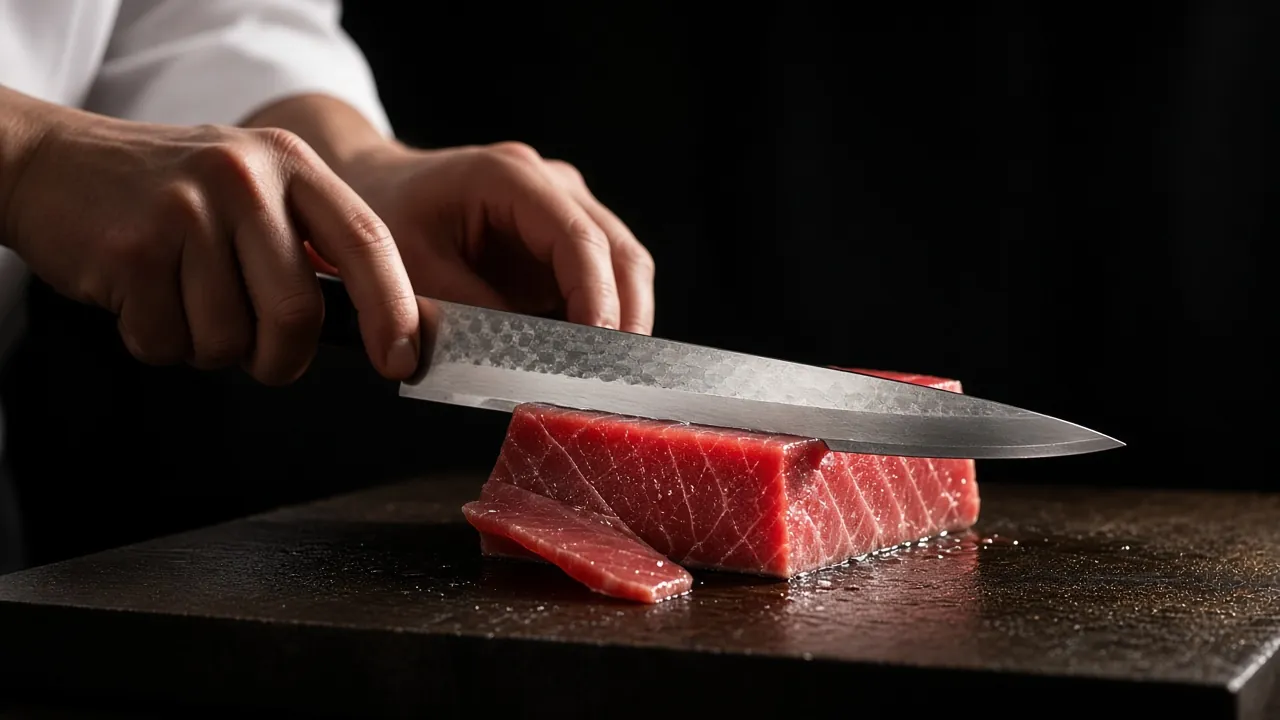
The basil test
Chiffonade basil with a dull knife and the cut edges turn black almost at once. Do it with a thin, sharp blade and, according to Korin, the leaves stay green for hours2. That small kitchen test explains most of what a Japanese knife is for. A thin edge cuts with less force and crushes less of the food.
Korin's comparison with German knives fills in the rest. Japanese blades are lighter, thinner and harder, and hold an edge a long time, which suits fine, precise work. German knives are thicker and heavier, and can go through bones and frozen food1. The basil stays green because of the thin, hard edge. That same edge is the reason the bones and the frozen food go to the German knife.
An edge ground thinner, and on one side
Traditional Japanese knives are single-bevel, sharpened on one face with a slightly hollow back. Korin says that shape gives a keener edge, easier resharpening and finer cuts1. Even Western-shaped Japanese knives are often ground off-centre, with more of the bevel on the front face, to come closer to single-bevel sharpness1.
Not every steel survives that treatment. Korin points out that such thin, uneven edges depend on good steel and heat treatment. A lower-grade steel would not hold the angle, and a less resilient blade would chip or crack when ground that thin1.
Harder steel, longer edge
Hardness is measured on the Rockwell C scale. A Tokyo retailer's glossary puts most Japanese knives at around HRC 58 to 64, with some very hard steels above that3. The same glossary spells out the trade. Harder steel with more hard carbides generally keeps its edge longer, and hard edges also chip more easily3. Korin puts it in buyer's terms. Soft steel sharpens easily and dulls sooner. Hard steel keeps its edge longer and takes longer to sharpen1.
The steel itself matters too. Traditional knives use high-carbon steels such as Shirogami and Aogami, which take a very fine edge and sharpen easily, but rust3. Modern lines often use stainless such as VG10 or powder steels such as SG2/R2, which the glossary describes as typically finished at about HRC 62 to 64 with good edge retention3. Our steel guide compares them side by side.
Hard steel on a soft iron body
A traditional Sakai knife is two metals, not one. Smiths forge-weld a very soft iron body to a high-carbon steel edge, and Japan's national crafts centre describes the result as a blade that neither breaks nor bends and cuts well4. Korin explains what that means in the hand. The soft iron makes the blade less brittle and much easier to sharpen than an all-hard blade5.
Honyaki breaks the rule. It is one steel throughout, and Korin says it keeps an edge longer than any other Japanese knife but is harder to sharpen and more prone to chipping, cracking or breaking if misused5. The Sakai maker Jikko says water-quenched honyaki is so hard to make that only a handful of craftsmen can do it6.
Sakai's tourism bureau also says that hammering hot steel makes its internal structure denser and improves strength and toughness7. That is the industry describing its own tradition. It is not a lab result.
Four regions, four ways to divide the work
Where a knife was made changes how many hands touched it.
Sakai, a relay of specialists
In Sakai, forging, sharpening and handle-fitting are separate trades, each with its own specialists7. The national crafts centre lists 27 sharpening stages for a Sakai knife, from rough grinding to the final edge4. The tourism bureau credits this division of labour for Sakai's quality7. It is also why a brand, not one smith, usually signs the blade, as our column on how to read a mei explains. Sakai Takayuki and Sakai Kikumori are Sakai houses in our index.
Tosa and Sanjō, one workshop from start to finish
Tosa, in Kōchi, prizes the opposite. The crafts centre notes that Tosa blades are valued because one workshop carries out the whole process while other areas divide it up. Tosa smiths can forge to a drawing of size and shape alone, a practice called "Tosa free forging"8. In Sanjō, Niigata, smiths are known for making everything from the blade to the tongs and other tools needed to make it9. Hinoura is a Sanjō workshop in our index.
Echizen, two blades under one hammer
Smiths in Echizen, Fukui, hammer two blades stacked together so both thin out evenly. They also set the steel edge with a method that tradition credits to Chiyozuru Kuniyasu, a 14th-century swordsmith10. In 1979 Echizen became the first cutlery region designated a national Traditional Craft10. See Echizen makers.
Seki, a sword town at industrial scale
Seki, in Gifu, grew from a sword town into a centre of modern cutlery. It makes kitchen and table knives, scissors, razors and more, and exports roughly a third of its output, according to the city's 2016 industry report11. Specialists work there too. Kei Kobayashi spent years as a sharpener finishing blades for other Seki makers before launching his own line, according to a retailer's profile12.
Forged by hand, or cut from sheet
Two methods sit under the one label. Uchihamono, 打刃物, are forged, with hot steel shaped by hammering. Stock removal cuts the outline from a steel sheet and grinds it into a blade3. Sakai's tourism bureau draws the same line between forged blades made by craftsmen and machine production that stamps blades out with a die7.
The glossary treats them as different methods, not as good and bad3. Forging gets you the traditional build described above, a hard steel edge joined to a softer body, in shapes worked by hand.
Why one brand spans so many prices
Part of the answer is how Sakai orders its knives. On the Kitchen Knife Forums, one experienced member explains that Sakai distributors commission knives from different makers. The higher the price point, the better the fit, finish and consistency the distributor asks for. Blades that miss the top standard often go into a cheaper line instead of the scrap bin16. That is one well-informed forum view, not industry data. A listing can at least tell you the steel, the construction, and whether a named smith or sharpener is credited. Our maker pages record who makes what, where the sources allow.
What a thin edge costs
Chips
Thin, hard edges chip. Korin asks owners not to cut very hard or frozen things such as bones and seeds1. Knifewear, a Canadian retailer, gives a rule you can remember: only cut food you could bite through, and skip frozen food, because cold makes hard steel more brittle still13. A new edge needs care too. The Tokyo shop Aritsugu warns that a freshly hand-sharpened edge is thin and chips more easily at first, so new knives should be used gently14.
Rust
Carbon steel rusts. Korin advises wiping carbon knives dry even mid-task, and notes that acidic ingredients discolour them, which is cosmetic15. Stainless is easier, but Korin still says to wash it after every use, because salt and acids weaken its protective film15. Stainless-clad carbon knives fall in between. Knifewear notes that only the exposed core can rust, and that it still needs wiping dry13.
Daily care and the right tools
Aritsugu asks for hand-washing, thorough drying, no dishwasher, and a thin coat of oil before long storage14. Korin does not recommend honing steels for Japanese knives, because they can damage hard steel, and advises against coarse oil stones, which can chip thin, hard blades1. Korin suggests soft cutting boards such as end-grain wood or polyvinyl acetate1. Knifewear rules out glass, granite and bamboo13.
Who should buy one
If you will wash and dry a knife by hand and either learn whetstones or pay someone to sharpen, a Japanese knife will suit you. For low maintenance, start with a double-bevel stainless or stainless-clad gyuto. Choose carbon steel for the most responsive edge if wiping it as you go doesn't bother you313. Keep a heavier European knife, or a deba, for bones and frozen food1.
New to the shapes? Start with what a Japanese kitchen knife is, then read a short history of how these towns came to make them.
A knife worn to half its width
Sakai's tourism bureau shows a knife that was sharpened regularly for about ten years. It has worn down to roughly half its original size. The bureau says a well-kept knife can be used until there is no blade left7. Each sharpening removes a little steel to bring back the thin edge that keeps basil green.
Sources
Pages the editors read for this column, as fetched on 17 October 2026. Retailer and forum pages are secondary sources and are labelled as such in the text. Statements we could not confirm were left out. Links to Hocho Knife, a shop we have an affiliate relationship with, are marked sponsored (disclosure).
- Korin (retailer, New York), "Japanese Knife FAQ". korin.com/japanese-knife-faq
- Korin, "About Japanese Knives". korin.com/about-japanese-knives
- Tenpos Chef's Knives (retailer, Tokyo/Osaka), Japanese knife glossary (Japanese). tenpos-chefsknives.com/ja/glossary-ja/
- Aoyama Square (Japan Traditional Crafts Center), 堺打刃物 (Sakai uchihamono). kougeihin.jp/craft/0710/
- Korin, "About Japanese Knives" (honyaki and kasumi). korin.com/about-japanese-knives
- Jikko (Sakai maker), "本焼包丁" (honyaki knives). jikko.jp/c/knowledge/detail/kouzou/honyaki-knife
- Sakai Tourist Guide (Sakai City Tourism Bureau), "世界が注目する「堺の刃物」の魅力". sakai-tcb.or.jp/feature/detail/18
- Aoyama Square, 土佐打刃物 (Tosa uchihamono). kougeihin.jp/craft/0713/
- Aoyama Square, 越後三条打刃物 (Echigo-Sanjō uchihamono). kougeihin.jp/craft/0706/
- Aoyama Square, 越前打刃物 (Echizen uchihamono). kougeihin.jp/craft/0709/
- Seki City, "平成27年度 関市の工業" (Seki industry report, March 2016), introduction. city.seki.lg.jp/cmsfiles/contents/0000004/4761/kogyo_h27.pdf
- Hocho Knife (retailer), Kei Kobayashi brand page. hocho-knife.com/kei-kobayashi/
- Knifewear (retailer, Canada), Fujiwara Maboroshi Nakiri 150mm product page (care and use notes). knifewear.com/products/fujiwara-maboroshi-nakiri-150mm
- Aritsugu (Tsukiji, Tokyo), FAQ: hand-sharpening and care. aritsugu.jp/%E3%82%88%E3%81%8F%E3%81%82%E3%82%8B%E3%81%94%E8%B3%AA%E5%
- Korin, "Elements of Steel". korin.com/about-elements-of-steels
- Kitchen Knife Forums, "What's the deal with Sakai Kikumori?" (forum thread, January 2025). kitchenknifeforums.com/threads/whats-the-deal-with-sakai-kikumori.7640
Written by The JKI Editors from the sources above, in our own words. Spotted an error? Email [email protected] and we will correct it.